Skip to Content
← All Odoo modules
Website
B2C + B2B

eCommerce

✳︎ Sell your products online, synced with real stock

A full online store connected to your real inventory: what customers see is what you can actually ship. Product variants, customer-specific B2B price lists, payment providers and shipping integrations work out of the box. Orders flow straight into fulfillment and accounting - no re-typing, no oversells during campaigns.

ORDER FLOW - LIVE
CARTPAIDSHIPPEDORDER €182PAID ORDER → WAREHOUSE → BOOKS, BY ITSELF
STRIPE / TWINT / CARDSLIVE STOCK
A shop that cannot oversell

The classic online-shop disaster is invisible until it happens: a campaign works, orders pour in, and the shop happily sells stock that left the warehouse yesterday. Odoo eCommerce cannot make that mistake, because the shop and the warehouse are the same system. Every product page reads live stock per variant; every order books it the moment payment lands.

No oversells, no re-typing - a campaign can’t break the warehouse.

The rest of the funnel is built in rather than bolted on: product variants with their own stock and photos, upsell and cross-sell blocks, customer-specific B2B price lists behind portal logins, abandoned-cart recovery, payment and shipping providers, click and collect. Orders flow straight to fulfillment and accounting with nothing re-typed.
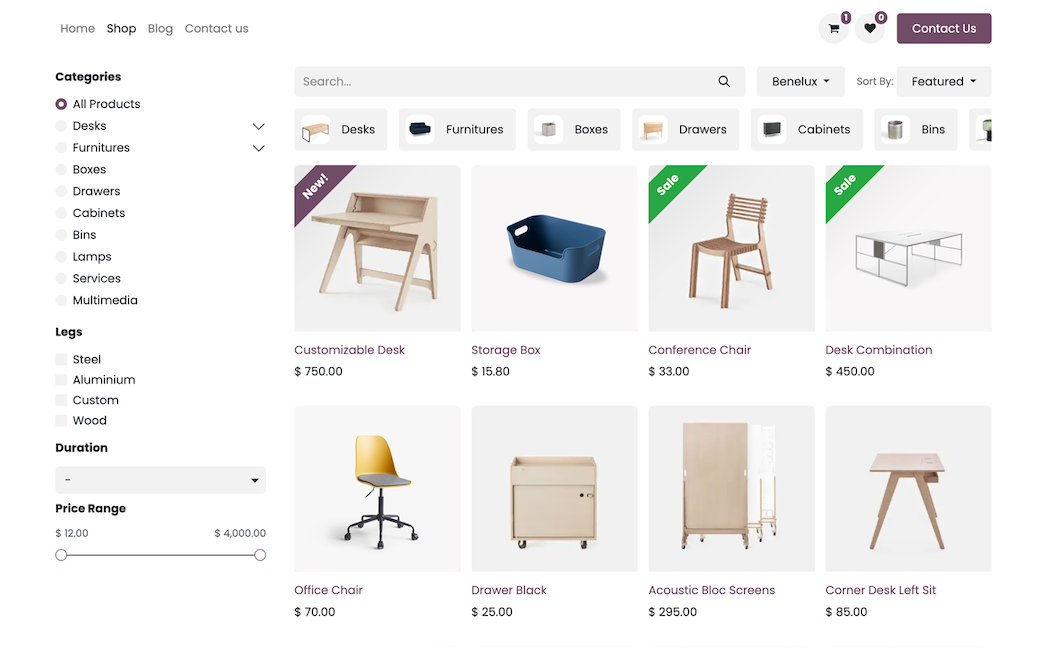
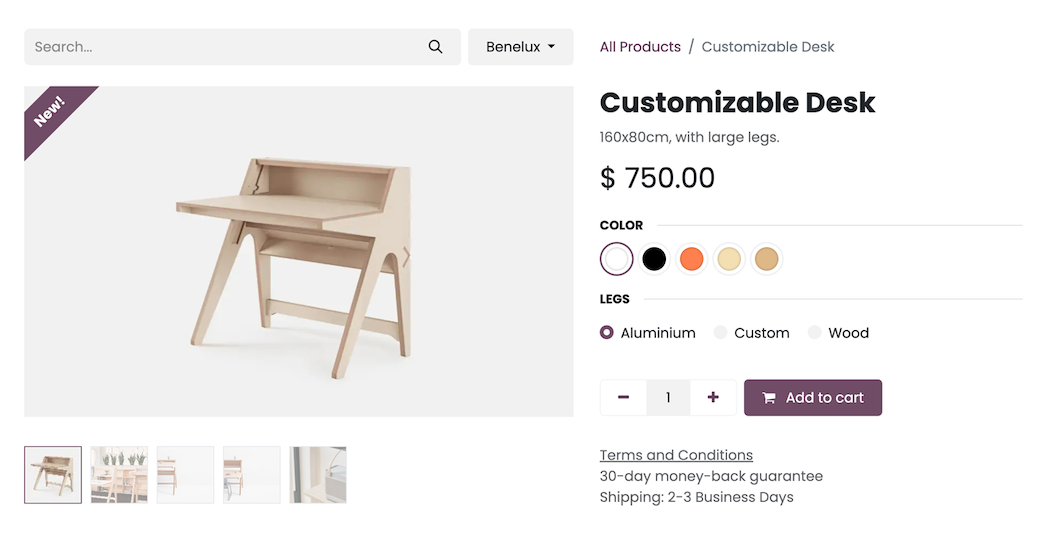
FIG.01 - STOCK BEHIND THE PAGE
MINMAXVARIANT: BLUE / MPAGE SHOWS: 3 LEFTUPDATED IN REAL TIMEWHAT THE CUSTOMER SEES IS WHAT YOU CAN SHIP
Technical drawing · live availability
How it works
the loop runs itself
STEP 01Customer opens your shop
STEP 02Sees live stock and their price list
STEP 03Pays online
STEP 04Order flows to warehouse and books
0
oversells: product pages read live stock per variant
1 database
shop, warehouse and accounting share the same records
B2B + B2C
price lists and portal logins per customer, one storefront
1 yr
free domain name included to launch your store
Inside the app
SOURCE: ODOO.COM
SCREEN 01 - THE STOREFRONT
Odoo screenshot: THE STOREFRONT
Business themes and styled product pages, assembled with the same drag and drop builder.
SCREEN 02 - VARIANTS
Odoo screenshot: VARIANTS
Sizes, colors and options, each with its own live stock and price.
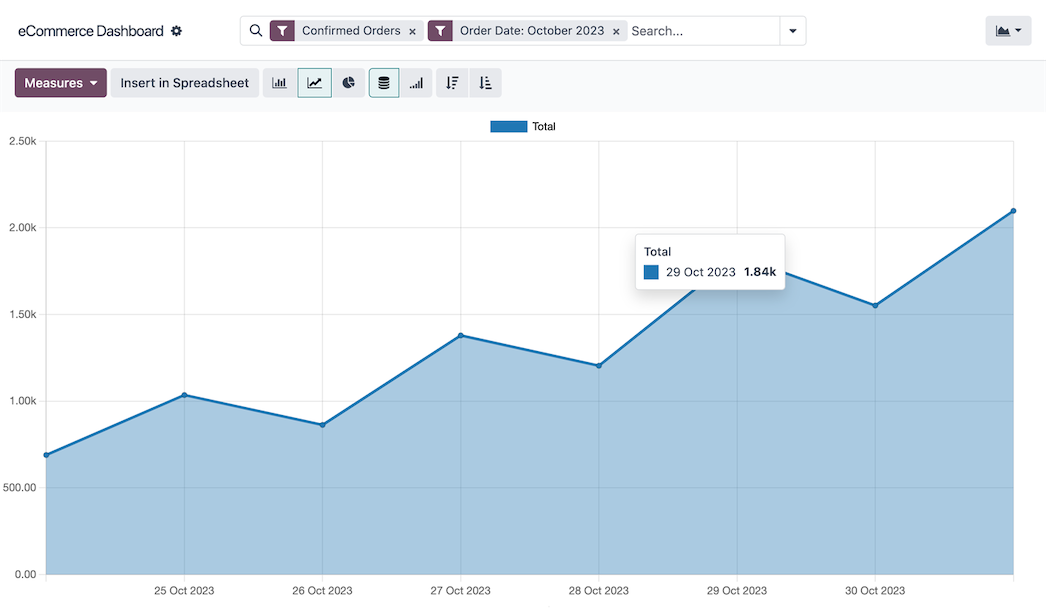
SCREEN 03 - ANALYTICS
Odoo screenshot: ANALYTICS
Built-in reports plus Google Analytics: see what actually sells.
Key capabilities
Spec sheet · 5 functions
Live stock on every product page
B2B price lists and portal logins per customer
Payment and shipping provider integrations
Abandoned cart recovery
Orders post to inventory and accounting automatically
In an ERPSWISS project
Part of our 7-step delivery
STEP 1Configure
We build your storefront and map variants, price lists and delivery methods to how you actually sell.
STEP 2Integrate
Orders post to Inventory and Accounting automatically: a strong campaign cannot break the warehouse.
STEP 3Train✳︎
Your team learns eCommerce in the training step of our 7-step journey, with your processes documented in your own Knowledge base.
Good to know

Odoo eCommerce: one module, one shared database, zero double entry.

Odoo eCommerce is one of the standard applications of the Odoo platform, part of the Website family. Like every Odoo module, it runs on the same database as CRM, sales, inventory and accounting: information entered once is available everywhere, with no connectors, no sync jobs and no manual exports. Companies choose it to replace a patchwork of disconnected tools with one integrated system that is easier to maintain and cheaper to own.

In daily work, teams rely on eCommerce for: live stock on every product page; b2b price lists and portal logins per customer; payment and shipping provider integrations; abandoned cart recovery. Because the module is part of the platform, every action leaves a clean trail for reporting: managers watch live dashboards instead of assembling spreadsheets, and the numbers stay consistent across departments and companies.

ERP SWISS is an official Odoo partner. We implement and configure eCommerce for companies in Switzerland, France, Germany, the EU and Armenia, including localization, data migration, staff training and long-term support. A typical implementation takes weeks, not months: we configure the standard module to your processes first, and add custom development only where it truly pays off. Book a free demo to see it on your own scenarios.

See eCommerce working on your own processes: on a free demo.
Book a Demo